
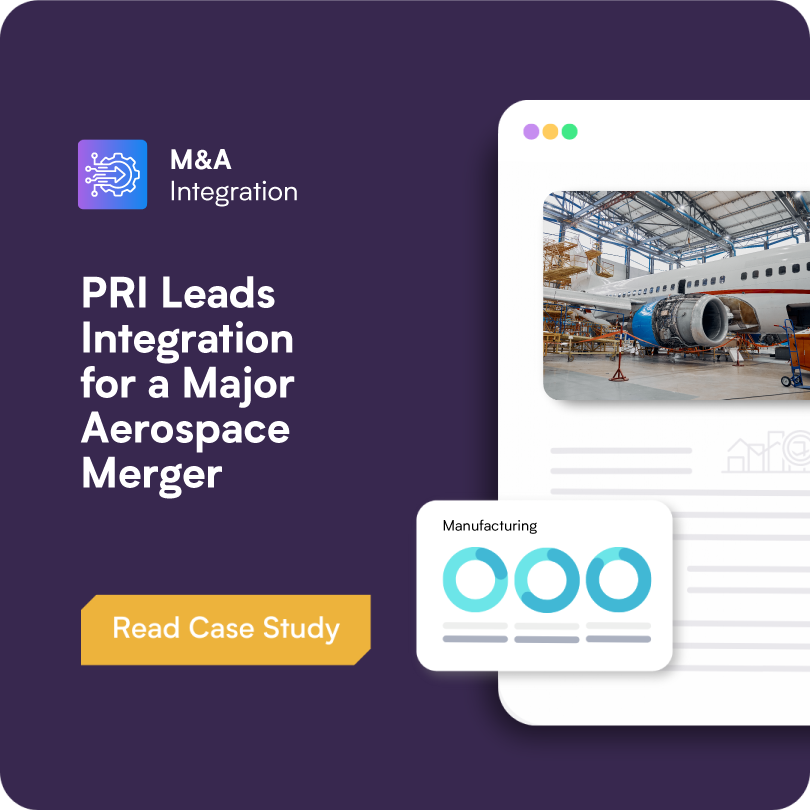
PRI Leads Integration for a Major Aerospace Merger
Reduction in operational downtime
Production efficiency improvement
Supply chain lead time reduction
Major operational disruptions
Challenge
Complex merger requiring full IT systems integration, data consolidation, and business process harmonization with zero operational disruption.
PRI Solution
Full IT integration, cloud migration, ERP unification, centralized data lake, advanced analytics, RPA automation, and comprehensive change management.
Client Background
A leading aerospace manufacturer, renowned for producing critical components for both commercial and defense aircraft, recently expanded its market reach by acquiring key assets from a prominent aerospace company specializing in aerostructures and aftermarket services.
This acquisition aimed to strengthen the company's supply chain and boost its competitive advantage. However, integrating the newly acquired company's systems, data, and business processes presented a significant challenge. PRI was brought on board to lead the integration, tasked with unifying IT systems, consolidating data, and streamlining processes while ensuring minimal disruption to ongoing operations.
Objectives
- Integrate IT Systems: Unify both companies' IT infrastructures for cross-compatibility with minimal operational disruption.
- Consolidate and Govern Data: Merge and standardize data to enhance reporting and decision-making.
- Harmonize Business Processes: Optimize and align workflows across various departments.
- Modernize Technology: Upgrade the acquired company's technology to match the acquirer's cloud-based approach.
- Ensure Stability: Maintain business continuity and mitigate operational risks during the integration.
PRI Global's Approach
1. Discovery and Assessment
- ›System Audits and Due Diligence: Detailed audits of ERP, supply chain management, and PLM systems to identify dependencies and compatibility issues.
- ›Data Mapping and Governance: Mapped data flows with attention to security and compliance; created a governance framework for data integrity.
- ›Business Process Analysis: Analyzed engineering, procurement, and aftermarket services workflows for alignment opportunities.
2. Technology Integration
- ›Cloud Migration: Migrated critical applications to modern cloud infrastructure with a hybrid model ensuring uninterrupted operations.
- ›ERP System Unification: Middleware solutions facilitated data exchange; full transition to the acquiring company's ERP completed.
- ›Supply Chain and PLM Integration: Unified systems enabling real-time collaboration in product design and supplier management.
- ›API and Middleware Solutions: Real-time data flow between different systems via API-based bridges.
3. Data Integration and Analytics
- ›Data Cleansing and Migration: ETL pipelines to cleanse, migrate, and validate data including historical records for future analytics.
- ›Data Lake Creation: Centralized data lake for structured and unstructured data enabling efficient reporting.
- ›Advanced Analytics Tools: Insights into production efficiency, supply chain optimization, and operational performance.
4. Process Harmonization
- ›Standardizing Workflows: Unified operational framework from engineering to procurement.
- ›Automation and Optimization: RPA implemented to streamline procurement and supply chain operations.
- ›Supply Chain Integration: Consolidated suppliers into a single procurement platform with improved tracking and lead times.
5. Change Management and Training
- ›Change Management Strategy: Leadership engagement, regular communication, and cross-functional workshops.
- ›Employee Training: Comprehensive sessions on new technologies; knowledge transfer for IT staff post-integration.
6. Security and Compliance
- ›Data Security Enhancements: Multi-layered security protocols protecting critical data per international regulations.
- ›Regulatory Compliance: All migration and integration activities compliant with industry-specific regulations.
Results
- Seamless IT Integration: Acquired company systems integrated without major disruptions — business operations continued smoothly.
- Data Consolidation and Insights: Centralized data lake and advanced analytics enabled more informed decisions; predictive analytics reduced operational downtime by 25%.
- Process Standardization: Workflow standardization and automation improved production efficiency by 15%, reducing bottlenecks.
- Supply Chain Optimization: Integration enhanced visibility, reduced material shortages, and cut lead times by 10%.
- Scalable Technology Infrastructure: Modernized technology stack enabling the client to scale and manage future acquisitions with greater flexibility.
Final Outcomes and Strategic Impact
PRI's successful collaboration ensured a seamless integration following the acquisition. By addressing the technical challenges of unifying systems, data, and processes, PRI played a pivotal role in enhancing operational efficiency and ensuring business continuity.
This case study highlights the critical importance of strategic IT consulting in mergers and acquisitions, particularly in industries where precision, security, and compliance are non-negotiable.
Next Step
Ready to achieve similar results?
Tell us about your challenge and we'll scope a solution tailored to your business.